
Twelve years of psychometric data on hospital leadership turns up a few things that don’t match the usual playbook.

Psynet Group works with several health care firms, including a Fortune 500 hospital chain. Why won’t our largest health care client hire someone without a Psybil Report? Because getting the right hire mattered from the start; what that hire actually looked like took years to learn. Twelve years into that work, I want to share three findings for the first time because they don’t align with what most hiring processes assume about strong leadership.
Psychometric assessment exists to close one gap: how a candidate performs in a room versus how they perform under six months of real pressure. In health care, the cost of that gap has stopped being theoretical for a while.
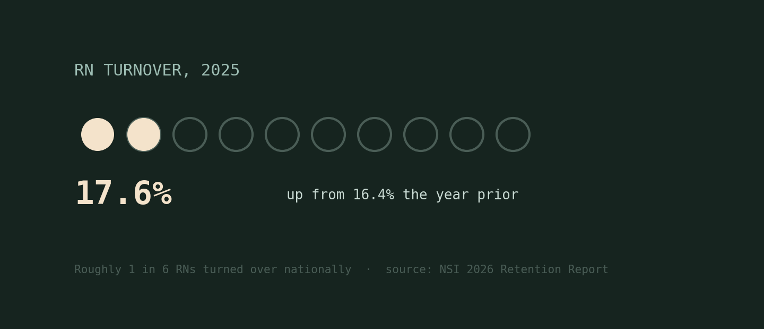
The number that should worry every CHRO in the building: National RN turnover hit 17.6% in 2025, up from 16.4% the year before, and the average hospital lost roughly $5.19 million to RN turnover alone, according to the 2026 NSI National Health Care Retention & RN Staffing Report. Every point of turnover costs the average hospital another $295,000 a year. Nurse-leader departures run higher still, often $132,000 to $228,000 per exit, because losing a leader rarely means losing just one person.
Behind the numbers are real people. Samantha, who brought cookies to her station every Friday, left when the supervisor she loved took a role across the river. Siobhan, who seemed to have an endless number of silly designs for her scrubs, took time off for burnout and never returned. The names go on.
What the resume can’t tell you
A resume proves someone survived a job. It says nothing about how they’ll behave when a unit is short-staffed, a family is furious, or a peer takes credit for their work. That’s where structured assessment pays off. The research isn’t close: Schmidt and Hunter’s meta-analysis, later revisited by Sackett and colleagues, ranks structured, validated assessment among the strongest predictors of job performance, well ahead of years of experience and the unstructured interview that most hospitals still lean on. No wonder Jason Dana, a Yale researcher, determined that no interview has better outcomes than the types of interviews most hospitals use today.
We’ve spent the past several years running that assessment on hospital executives specifically, not generic corporate leaders, and the profile that emerges is distinct enough to change how you read candidates.
Finding one: warmth without softness
Hospital executives tend to land in the moderate range on empathy and connection traits: collaboration, sentimentality, and need for affection. Not low. Not high. Moderate. The internal executive recruiter called them “Tender but Tough”.
That surprises people who assume the best health care leaders are the warmest ones. A CNO candidate who scores high on sentimentality often struggles to deliver a hard performance conversation to a beloved but underperforming nurse. One who scores low can’t hold a care team together during a bad shift. The executives who live in this environment aren’t the most caring people in the room. They’re the ones who can care and still hold a line.
Finding two: honest about their own limits
Most executives from industries other than health care are naively optimistic about their own abilities. That’s normal, and it’s rarely narcissism. This is not true among Hospital executives who run lower on self-deception than their peers in other sectors.
The reason isn’t mysterious. A hospital executive who overrates their own judgment gets caught fast, because the consequences of bad judgment show up in a patient outcome, not a quarterly report. Boards and peers actively punish hospital leaders who read as overconfident, labeling them reckless rather than bold. The same discipline shows up in moderate opportunism scores: hospital leadership selects against the swing-for-the-fences operator that other industries sometimes reward. This is why a generic leadership profile fails in healthcare.
Finding three: the job demands a flexible mind
Every executive role benefits from abstract reasoning. Hospital leadership needs more of it than most. Clinical environments constantly throw novel, non-repeatable problems at leaders: a supply shortage during a mass casualty event, a staffing crisis during a surge, a regulatory change that hits mid-shift. There’s no playbook for many of the problems. The executives who thrive are the ones who can reason through a genuinely new problem, not just execute a familiar one faster.
Put a low-abstract-reasoning executive in a high-volatility unit, and the consequence isn’t incompetence. It’s brittleness. They perform well until the first novel situation and then the team learns to route around them.
Where this saves you money
These are only three of many scales used to assess CEOs, CNOs and other leaders. None of this shows up on a resume, and most of it doesn’t in a panel interview either, because interviews reward charisma and fluency, not the traits that predict an eighteen-month survival rate. That’s exactly how derailers slip through: the brilliant surgeon whose perfectionism curdles into abrasiveness, the charming department lead whose need for control erodes trust one meeting at a time. Nobody flags it here. Everyone flags it at exit.
Assessment doesn’t replace your clinical vetting or your reference checks. It fills the part of the picture neither one was built to see: how this specific person, with this specific profile, holds up when the floor gets hard.
I think about that board more than I’d like to. Their candidate wasn’t a bad hire because he lied in the interview. He was a bad hire because nobody looked past it.
That’s the half of the candidate the resume and the room will never show you, and it’s the half that predicts the most.
If this piqued your curiosity, reach out. I’m happy to walk you through what we’re seeing across the accounts we work with.