
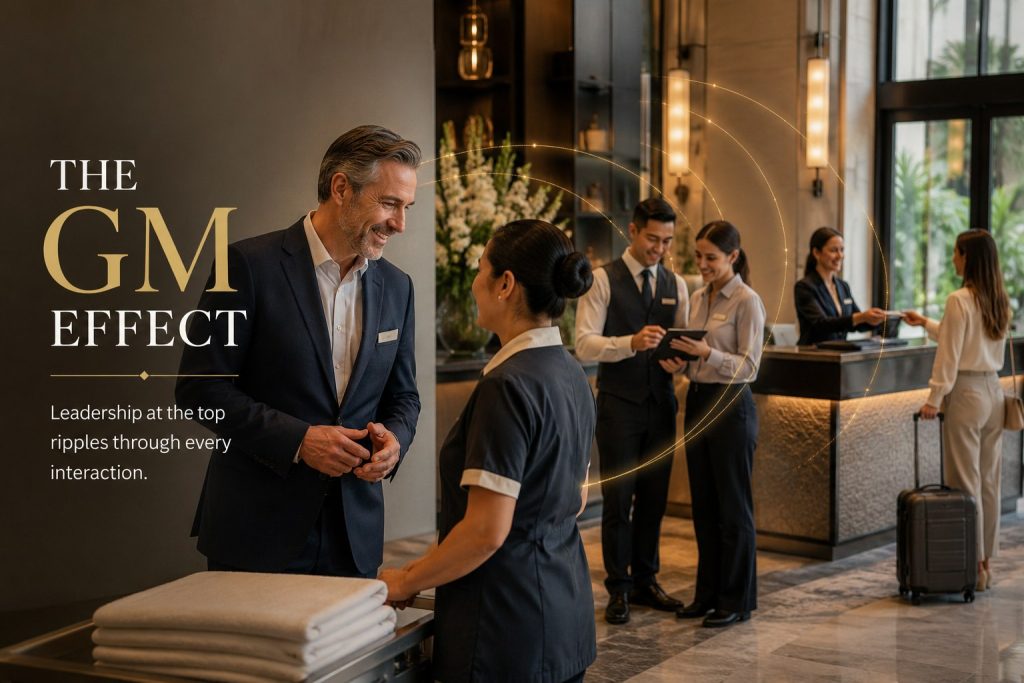
Every GM we have assessed or encountered, both in a large hotel chain or a mid-sized resort chain, started at the lowest level of the organization. One started cleaning rooms, and another at the front desk. They throw around the term “lifers” to describe themselves.
Their education has been through hard knocks. Late nights, low pay, unappreciated and so on makes them feel like they really earned their position. It also creates a mindset that others should also pay their dues.
Because they have spent so many years of their lives in hospitality, they often lose site of what is needed to retain employees. But Hospitality has a turnover problem that’s now well documented, the research on why some properties keep their people, and others churn through them, points less at wages alone and more at who is running the building day to day.
Could it be that the mindset that kept GMs engaged for so long is now contributing to why others are not?
Let’s explore what the data actually shows about hospitality turnover, what the academic research says about the specific leadership styles that predict whether staff stay or go, and why that same leadership signal is so hard to catch with a hiring process limited to an interview and background check.
70–74%
Annual turnover in U.S. accommodation & food services, per BLS data
40–60%
Typical annual front-line turnover at well-run, full-service hotels
$5K+
Average estimated cost to replace a single hospitality employee
Figures compiled from U.S. Bureau of Labor Statistics JOLTS data and industry sources including Netchex, Cloudbeds, and SHRM’s 2025 Benchmarking Report; rates vary by role, region, and property type.
A Turnover Problem That Isn’t Just About Pay
Accommodation and food services consistently rank among the highest-turnover sectors the U.S. Bureau of Labor Statistics tracks, with quit rates roughly double the private-sector average. Wages and scheduling are part of the story, but they’re not the whole story. Peer-reviewed research on hotel staff consistently finds that leadership style is an independent predictor of turnover intention, separate from pay and hours.
A 2021 study in Tourism and Hospitality Research, along with related work on leadership styles in five-star hotels, found that transformational leadership — leaders who coach, involve staff in decisions, and model the standard they expect — was associated with meaningfully higher job satisfaction than transactional or autocratic styles. Autocratic leadership, command-and-control management with little staff input, was the one style consistently associated with lower satisfaction and higher turnover intention across multiple studies in the sector. Ironically, it was often the style these same leaders experienced early in their own careers — a style that was modeled for them.
The leadership style at the top of a property doesn’t just set the tone. In the research, it’s a measurable, independent predictor of whether staff stay or leave.
Why this is hard to see from the outside
A general manager candidate’s resume shows properties managed, revenue delivered, and brand scores hit. It rarely shows how that GM actually got there — through steady coaching and staff development (transformational leadership), or through pressure, fear, and a revolving door of new hires covering for the ones who just left (autocratic).
This is a known blind spot in hiring research more broadly: interviews are good at surfacing how someone talks about leading, and much weaker at surfacing how someone actually behaves once they have authority and are under sustained pressure — a slow season, a corporate inspection, a staffing shortage over a holiday weekend. The behaviors that erode a team — micromanagement, favoritism, blame under stress — tend to stay invisible to anyone above the property level until the turnover numbers or guest scores already show the damage.
| Leadership style | Association found in hospitality research |
|---|---|
| Transformational | Consistently linked to higher staff job satisfaction and lower turnover intention across multiple hotel-sector studies. |
| Transactional | Positive but weaker association with satisfaction than transformational leadership — clear expectations and rewards, less staff development. |
| Laissez-Faire | Mixed findings — some studies show a positive link to satisfaction, others find no significant effect, suggesting it depends heavily on staff experience level. |
| Autocratic | The one style repeatedly associated with lower job satisfaction and higher turnover intention in hospitality-sector research. |
How the GM effect reaches the guest
Consider a well-known story from inside the industry: a visitor to a major hotel brand’s headquarters was struck by how welcoming the front desk staff was at check-in, and how someone on the elevator eagerly walked them to their appointment. Everyone was incredibly hospitable. When the visitor mentioned it, the head of learning and development explained that things had changed over the past six months — ever since a new chief executive had come on board. He made a habit of asking line cooks about their families, remembering personal details, and writing handwritten notes of appreciation and congratulations. The change flowed from the top down.
That connection between leadership style and turnover matters beyond the HR line item, because turnover itself is a service-quality problem. Every departure resets institutional knowledge, and every open role gets filled — temporarily — by someone still learning the property, the systems, and the standard. Research on frontline hospitality management has found that when managers are caught choosing between rigid corporate directives and the flexibility staff need to actually serve guests well, both staff wellbeing and service climate suffer — a dynamic that shows up in guest experience even though the guest never meets the GM.
In other words, the leadership qualities that keep a team intact — coaching over command, consistency, follow-through on commitments to staff — are the same ones that indirectly protect guest experience, simply by keeping experienced people in the building instead of restarting the training cycle every few months.
What doesn’t show up until it’s expensive
Because leadership style is largely invisible from the outside, the cost of a mismatch tends to arrive late and all at once: a spike in departures, a slipping guest-satisfaction score, or a corporate inspection that surfaces standards that quietly slipped. A few patterns the research and industry data point to as recurring, expensive blind spots:
- Directive rigidity. Corporate frameworks applied rigidly, with little room for a GM or department head to adapt to their specific team or property — a trait common in autocratic leadership.
- Standards that don’t outlast supervision. A property that runs well only while a specific leader is watching, with standards slipping the moment they’re not — another trait common in autocratic leadership.
- Uneven attention. Coaching and opportunity concentrated on a small group of visible staff, leaving the rest of the team under-supported and more likely to leave — a common trait in laissez-faire leadership.
- Pressure without follow-through. Short-term compliance on metrics, at the cost of the trust and morale that keep staff through a hard season — another common trait in laissez-faire leadership.
None of these are visible in a reference call. They tend to surface in assessments that measure the core factors behind these styles. Sometimes a leader has been on-site for a while and the reason for poor retention still isn’t clear — which is when structured, multi-rater feedback (gathering input from peers, direct reports, and supervisors, rather than relying on one person’s impression) becomes an invaluable tool for evaluating operational leadership.
The takeaway
The data is consistent on two points: hospitality’s turnover problem is real and expensive, and leadership style — more than compensation — is one of the measurable levers behind it. Yet according to Yale researcher Jason Dana, it may be more effective to have no interview at all than to follow the common interviewing practice used at most hotels. That’s precisely why an objective, valid, and reliable assessment that measures leadership styles and the derailers that create toxic cultures is so important.