
We informed a client that a background check showed their employee had an extensive criminal record and substantial debt, neither of which she disclosed. This person had access to the company’s funds and was in a position to take kickbacks. Part of our human capital due diligence includes an assessment, and this individual scored a 95 on Impression Management. Simply, impression management measures how much someone intentionally inflates their answers to impress the assessor.
Our process detects derailers like Narcissism, Sociopathic tendencies, and other characteristics candidates want to hide better than any other assessment on the market. It’s how we prevent our clients from getting their asses kicked when they hire for critical positions in their organization. But what about cheaters, liars, and those with high impression management scores?
I take that personally, more personally than most articles I write. The idea that someone would attempt to cheat my psychometric feels disrespectful to the employer who invested in attempting to get to know the candidate. It also strikes me as shortsighted because employers will eventually get to know the candidate. When they realize the person in the position doesn’t match the person who applied and interviewed for it, neither side benefits.
Cutting corners, scheming, and thinking of ways to get away with a little trouble come naturally to many people. Even me. When I shop with my wife, watching her try on a dozen outfits gets old. Inevitably, I tap into my criminal mind and think about how one could get away with negating the censors, evading the cameras, and walking out with a dress free and clear. I never do, but I like thinking about it. When I catch people trying to deceive my assessments, I feel like I’m on the other side.
My clients and the candidates deserve an assessor who can determine if they try to cheat their way into a position. Hiring mistakes cost companies and result in failed hires all the time, and this happens with both expensive portfolio managers and early career hires. Our assessments have saved tens of millions of dollars, and trying to cheat them puts future savings at risk.
A lot has been written about toxic behaviors, but we do not hear as much about attempts to hide those behaviors on the tests designed to reveal them. Self-deception and sociopathic tendencies do not impact our tool, but less toxic factors do see an impact. Psychometric data on toxic behaviors does no good if you can’t trust it. Garbage in, garbage out.
Candidate fraud is everywhere.
Attempts to fool psychometrics go back more than 80 years, when the developers of the MMPI (a famous personality test designed to look for depression and dysfunction) applied the uncommon virtues solution to their psychometric. The behavior continues today, potentially becoming worse. According to HireRight’s employment screening benchmark data, about 46% of resumes include at least one discrepancy between what is submitted and what turns up in a background check. That figure captures only what gets caught. Separate survey data shows that around 46% of job seekers admit to being dishonest about years of experience, and about 44% are not fully honest about their education (CreditDonkey, 2022).
While some people lie to some degree on their experience or education, put together, a Stanford Social Media Lab study found over 90% of participants lied at least once on their resume. Research distinguishes between two forms of deception: embellishment and fabrication. Embellishment involves exaggerating work experience, like claiming four years in a role that only lasted two. Fabrication is intentionally falsifying information throughout a profile. This includes work history, degrees, certifications, and other credentials. Most candidates who lie choose to embellish because it feels more like optimism than fraud.
The same research from Stanford also identifies how candidates choose to structure their deceptions. Verifiable claims, such as educational background, carry significant risk if made public. Hobbies or interests are not as easy to verify and less likely to come across as deceptive, and candidates know it. Candidates lie where they can and hedge where they cannot.
What does this have to do with psychometrics? A candidate who embellishes a resume has already decided that misrepresenting themselves to get a role is acceptable. They calculated the risk, and decided to walk across the ethical line. Those candidates overwhelmingly believe deceptions on a psychometric are harder to verify, so likelihood of exaggeration and lying increases.
Now, AI has made it even easier.
The AI factor
According to HackerRank research, 14% of candidates have admitted to using generative AI tools to help with online assessments, results similar to our experience at Psynet Group. A staggering 83% say they would use AI assistance if they thought they would not get caught. As the world economy shifts, the stakes are becoming higher, and the pressure to cheat increases.
Test Partnership, a UK-based assessment firm, notes that traditional cognitive assessments relying on static questions are particularly vulnerable to cheating. Personality test, on the other hand, present a different challenge. AI cannot tell a candidate exactly which trait to express, but it can coach them on which answers signal desirability for a given role. A candidate who has already engineered their LinkedIn presence for a specific audience knows exactly what to feed the prompt.
In short, there’s no line between candidates willing to misrepresent their tenure, title, or degree and those willing to deceive an assessment. Assessment integrity is just one level down on the ethical funnel.
Two Things Liars and Psychometric Cheaters Have in Common
They leave tracks
Chronic dishonesty expresses itself in signature ways. Current Psychology published research on pathological lying and describes it as persistent, pervasive, and compulsive. Before I developed Psybil and considered becoming certified in assessments myself, I asked a master trainer for a well-known assessment company about impression management. He explained they treated it like police interrogations. When police ask suspects to retell their stories over and over again and ask them about minute details. The guilty ones cannot keep their stories straight.
Several assessments use the same technique. They use repeated or reworded questions to catch inconsistency, but some execute it in different ways. Hogan includes a Validity Scale of 14 embedded statements designed to detect inconsistent, careless, or overly managed answering. Caliper does the same thing, but they are not as transparent about the mechanism.
Neuroscience tells us why those approaches fail in assessments while they succeed with criminals. Research by Tali Sharot at University College London showed that amygdala responses to dishonesty diminish with repetition. In other words, the brain habituates to its own lies. The emotional friction between truth and fabrication weakens, the cognitive effort required drops, and the behavior becomes automatic. What began as a calculated exaggeration becomes the truth (in their mind). Habitual liars return to reliable forms, familiar framings, and preferred numbers, so trying to catch them in an inconsistency goes against neurological facts.
Here’s a prescient example. No one has demonstrated the reliance on patters in their deception more publicly than Donald Trump. Writing in The Atlantic in December 2025, Marie-Rose Sheiner documented what fact-checkers had begun treating as a behavioral tell: Trump’s persistent use of 92 percent in claims that later proved demonstrably false. He claimed to have won Wayne County, North Carolina, by 92 percent. The actual margin was 16 percentage points. He asserted the U.S. controls 92 percent of the Gulf of Mexico’s shoreline. The real figure is closer to 46 percent. He told Politico that drug trafficking by sea was down 92 percent.
Trump’s deceptive statement follows a pattern because he does not want to increase his cognitive load by reinventing the truth every time.
They overshoot
Cheaters tend not to have a reliable internal sense of what a believable result looks like, so they go too far. The Dunning-Kruger framework explains why this happens. As a quick reminder, Dunning-Kruger states people with little experience overestimate their knowledge and abilities. As they learn more, their confidence dips because they start to understand how much they don’t know. Experts regain confidence, but it doesn’t reach the level of confidence near-beginners have. We look for answers in the confidence gap to identify cheaters.
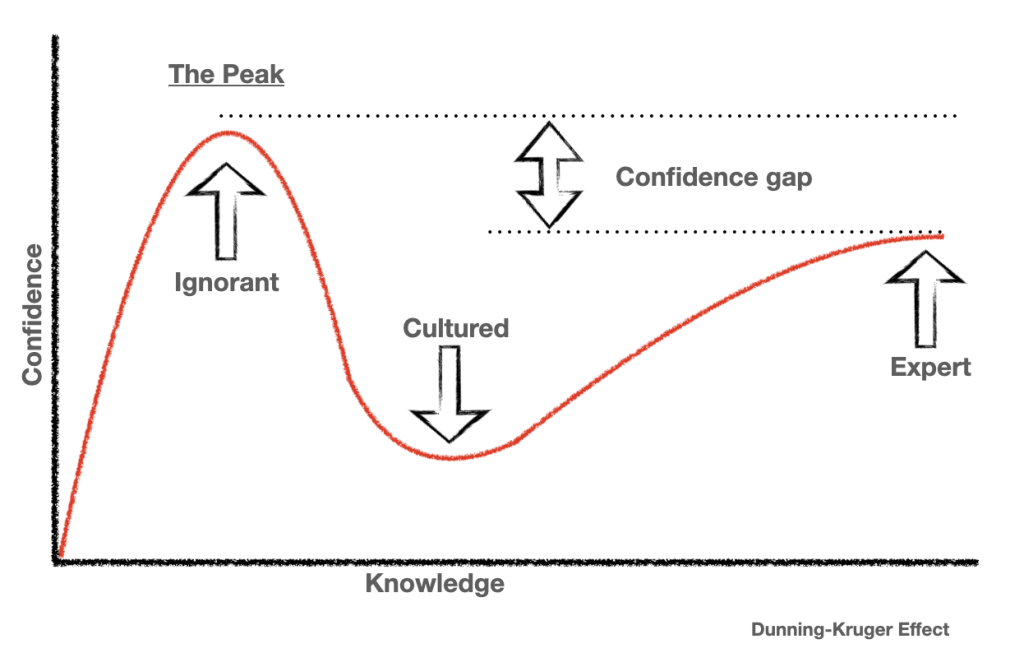
A 2021 study published in Frontiers in Psychology found that participants who scored in the bottom quartile on a cognitive reflection test overestimated their performance most severely. This finding means two things. First, lower caliber candidates experience more self deception and second, they lack awareness of truly effective vs fabricated. Low performers lack the metacognitive ability to recognize what good looks like, so they cannot accurately model it and thus struggle to give believable answers.
Apply this to assessment fraud. A candidate who genuinely scores in the 70th percentile on a predictive factor has internal reference points. They know what that factor feels like and can recognize a ceiling. A candidate gaming the same test through AI has no such anchor, so they produce outputs without experiencing the underlying cognitive process. When asked to select an item, they pick a number that sounds impressive rather than one that fits their profile.Maximum positive impression across every item. The result is a profile no real person produces. It’s Trump’s 92 percent error. When you do not know what realistic looks like, you reach for the impressive, which are not the same number.
AI Bandit vs. AI Sheriff: How we catch cheaters
Note: I’m not willing to share exactly the algorithms we use to catch cheaters. If you are reading this far with the hope of learning how to cheat a psychometric or a competitor looking for answers, you will leave this article disappointed.
Deceptive patterns leave a physical record
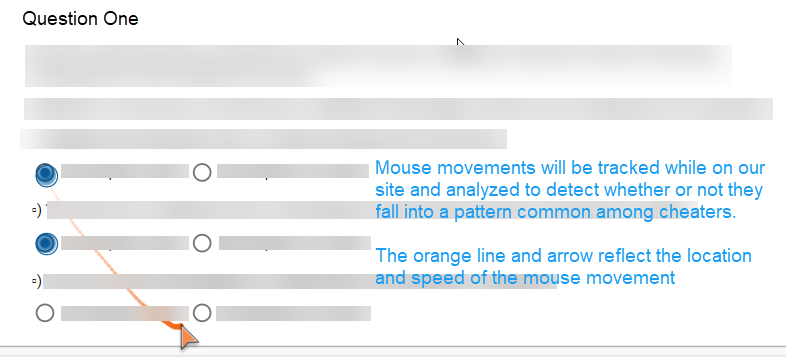
The first detection layer operates at a level below content. Psybil monitors behavioral patterns throughout the assessment, including mouse movement data. This is not a new idea in psychometrics, but it remains underused. Research published in PMC on MMPI-2-RF faking detection found that machine learning algorithms accurately identify fakers 95% of the time by analyzing response timing and behavioral features.
Honest responses draw on autobiographical memory: a person recalls an actual experience and matches it to an answer. That process takes time and produces natural variation in response latency. Research on MMPI response latency found that participants in faking conditions respond differently from those answering honestly, because evaluating the social desirability of an item is a different process from retrieving a genuine memory. Faking good behavior relies on selection, not recall.
Mouse movement and camera images capture obvious tells, like holding up your phone to take a picture of the screen or consistent lip movement indicating speaking. Psybil continues to build its research base on these behavioral signatures, developing normative data on what genuine responding looks like for the specific populations it serves. Cheaters leave a physical record, and technology helps us decipher it.
A blurred image from our mouse detection software.
The deeper layer comes from one of the most rigorously validated instruments in clinical psychology. The MMPI-2 includes a validity scale called the L-r, formally designated Uncommon Virtues. Its logic, described in both the StatPearls clinical review and the MMPI-2-RF technical literature identifies underreporting through the endorsement of infrequently declared values or actions. These questions present test takers with options that put them in a positive light but are statistically rare. Almost no honest responder can claim them all. A person who tries to signal exceptional virtue across the board really reveals they do not know where the ceiling is.
A PubMed-indexed study on MMPI-2 faking detection distinguished two strategies for faking-good: denial of ordinary human flaws, and claiming extreme virtue. The latter is harder to suppress because it requires the test-taker to identify items as desirable and resist endorsing them, which people who attempt to game a questionnaire do not do. They select positive answers without modeling the population’s realistic distribution of positive items.
Psybil applies the same principle. We embed positive but uncommon answers throughout the battery. A candidate who claims a handful will fall into the normal range, but one who claims most of them creates an unlikely profile. Then we flag them and give them high impression management scores. Earlier I said I would not give cheaters a path to deceiving the assessment. It may seem like I just did. With more than 40 card-stack questions, keeping track of that much data would be almost superhuman. Even if someone is prone to cheating, it would be nearly impossible to apply this effectively.
In summary
Psychometric Assessment fraud is accelerating, but it’s not new. Candidates who have already decided they can misrepresent themselves on a resume will come to the same conclusion when they get to the personality questionnaire, especially when AI makes coaching that questionnaire effortless. But we know the tells, understand the consistent patterns, and can predict how much they will overshoot their answers. The question is whether your assessment infrastructure is built to find them.
Psybil was designed with that question in mind. If you want to understand how behavioral monitoring, response timing, and uncommon virtue detection work together in a live assessment context, or if you are evaluating whether your current psychometric battery has the validity architecture to catch what candidates are hiding, reach out to us at [email protected]. We are happy to walk you through the research and the approach.”
In Other News:
Harper Collins, the prestegious publisher, recently agreed to publish my book. It explores why some people with incredible work ethic and immense talent lose their edge, stall out, burn out, self-sabotage, or fail while others rise to greatness.
We all have nine psychological selves within us, and the difference between a high performer maintaining success or falling apart is determined by whether or not they can unify those nine states. The book introduces this new psychological paradigm, shows how misalignments limit our potential, and demonstrates how getting them aligned is the key to sustained success in any endeavor and for overall satisfaction in life.
Subscribe to our Substack here for more information, like a publication date and other announcements. You can also find previous articles from our blog and newsletters you may have missed there as well.