
Executive Summary
Elite university credentials no longer predict workplace performance. When 38% of Stanford undergraduates register as disabled—versus 3-4% at community colleges—and transcripts reveal nothing, employers face a hidden risk.
The Credential Crisis:
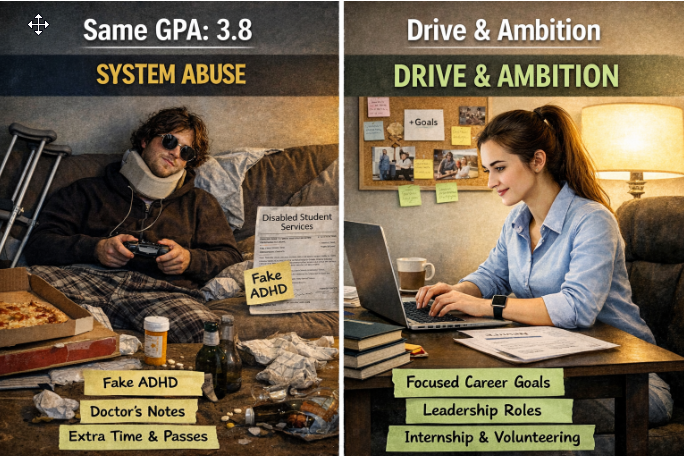
- Two Stanford graduates with identical 3.8 GPAs may have earned them under completely different conditions—one under standard testing, another with double time, 48-hour extensions, and excused absences
- Our 2018-19 assessments of 64 elite degree holders revealed a 24.2-point standard deviation in abstract reasoning—high performers clustered at 85-99, low performers at 30-50
- By 2022, 84% of high performers remained employed or advanced; only 1 of 11 low performers stayed in their role
- The accommodation system advantages wealth: testing for ADHD/anxiety documentation costs $1,500-$10,000, creating an equity gap that inverts the system’s stated purpose
The Employment Reality:
- Universities can grant unlimited time; employers cannot eliminate timeliness as an essential job function
- The ADA protects qualified individuals who can perform essential functions with accommodation—not those who cannot meet core requirements.
- Statistics reveal that Gen Z employees already face terminations for failing to meet basic organizational and deadline standards.
The Solution: Psybil provides the predictive signal that GPAs once offered but can no longer. Our assessments measure real-world performance under standardized conditions—the same conditions candidates will face on the job. When credentials lose their meaning, objective assessment becomes essential.
More than Grade Inflation
The issues surrounding grade inflation have been around for a decade or so now. A 2023 analysis by Michael Hurwitz and Jason Lee published by the College Board found that high school GPAs rose significantly during 2020-2021, with the average GPA increasing from 3.17 in 2019 to 3.36 in 2021 (https://research.collegeboard.org). Yale reported in 2023 that 79% of grades awarded were A- or higher. Research from BestColleges.com analyzing data through 2022 found that private schools showed even steeper grade inflation than public institutions, with some elite colleges reporting median GPAs above 3.6.
But there is another source of error in academic credentials.
I loved teaching in the Graduate School. When the local university first offered me an adjunct role, I was so excited to meet my first class. I was not disappointed. This group of students was curious, quirky, and well prepared for class. I would often sit at the desk and diagram answers to their questions. Sometimes we debated ideas, and the course almost always went overtime. Because I had a solid grasp of theory, technique, statistics, and research methods, I taught several of the graduation requirements. One student estimated that I was responsible for 40% of her graduate education. They joked that they received a degree in Popple.
But then they graduated, and a new cohort arrived. Before the semester started, the program’s dean asked me to stop by his office before the first class. He explained that a student in this group needed additional accommodations. Empathically, I was eager to help and assumed that she was a gritty student who had overcome difficult obstacles to get to this point.
My first hint of concern came during class discussions. Although the first cohort had conditioned me to teach mainly through discussion, this special-needs student did not participate. She was clearly social and had friends in the class, but when it came time to share her ideas, nothing. Then I called on her, and she seemed baffled by my question.
When midterms arrived, the dean’s office told me that she needed someone to read the test items to her. The school had volunteers for this, and her reader was another classmate. Her effort merited a C. When I distributed the results the next week, it was clear that she was upset. After the class, her reader approached me and shared that she felt like she had been part of cheating. The special needs student asked so many clarification questions that she felt was giving the answers. When she learned about the C, she felt like maybe she had given her the wrong answers, despite receiving an A on her exam.
Then the special needs student’s mom called the dean, but this is a story for another time.
From 2002-2005, this is the only instance of a student who needed accommodations out of ~50 who took a class from me. In 2026, it appears that the numbers have grown exponentially.
This article is not about students with legitimate obstacles who have fought through them to succeed; it is about distorted academic credentials resulting from some students taking shortcuts and professors whose conflict-avoidance inflated grades.
When Elite Degrees Stop Meaning What They Used to Mean
Imagine a hiring manager at a Fortune 500 company reviews two resumes. Both candidates graduated from Stanford with 3.8 GPAs. Both majored in economics. Both look identical on paper.
One completed every exam under standard conditions. The other received double time on tests, 48-hour extensions on assignments, and excused absences throughout four years. The transcript reveals no difference. The diploma carries the same weight. The hiring manager has no way to know.
This scenario plays out thousands of times each year as graduates from America’s most selective universities enter the workforce with credentials that may not reflect comparable performance.
This is not only a hypothetical situation. In 2018-19, we conducted 64 assessments of early-career professionals under 25 with elite degrees. The disparity on our abstract reasoning test was significant (The Standard deviation = 24.2 points). The large standard deviation reflects the bimodal nature of this group. On one end was a cluster of high performers (85–99), and on the other, a smaller cluster of low performers (30–50). Looking at the resumes, you could not tell the two groups apart. By 2022, the difference between those who were hired and remained in their jobs and those released was clear. Eleven low-performing applicants were still hired; by 2022, only 1 remained and had not been promoted. 84% of the high-performing hires were either still in their jobs or had been recruited to a higher-paying position elsewhere.
What do accommodation rates at elite schools reveal about credential reliability?
The numbers defy intuition. At Stanford, 38% of undergraduates are registered as having a disability; in the fall quarter, 24% of undergraduates were receiving academic or housing accommodations (Palo Alto Daily Post). At Brown and Harvard, 20 percent of undergraduate students are disabled, as are 34 percent at Amherst College. Reason Magazine
Compare these figures to community colleges, where only three to four percent of such students get accommodations Reason Magazine. The institutions that serve students with genuine economic and educational barriers report rates that are 10 times lower than those of schools that admit only the academically elite.
One factor in the increased rate began in 2008 when the government broadened the definition of disability, effectively expanding the number of people the law covered. Palo Alto Daily Post When the latest edition of the DSM, the manual clinicians use to diagnose patients, was released in 2013, it significantly lowered the bar for an ADHD diagnosis. Substack
This reality represents a fundamental shift in what elite credentials actually certify
The Qualification Gap
Steven Sloman, a cognitive-science professor at Brown, articulated the core problem to The Atlantic: “If we want our grades to be meaningful, they should reflect what the student is capable of. Once they’re past Brown and off in the real world, that’s going to affect their performance.”
Harry Lewis, former dean of Harvard College, captured the broader concern: “The whole system of accommodations for things other than physical disabilities just seems badly mismatched with the educational purposes that students and faculty share.” Yahoo!
The mismatch extends beyond education into employment. Our assessments typically don’t come with accommodations, and performance is based on speed, accuracy, and consistency. A graduate who earned high marks with double time has not faced the real-world situations that assessments like Psybil predict.
Reason Magazine states that if a student masks the impact of learning deficiencies with extra time on texts, soothes social anxiety by forgoing presentations, and neglects time management skills with deadline extensions, they may forge a path to better grades. However, this may not adequately prepare them to tackle the challenges of adult life.
The Gaming Mechanics
Students secure accommodations through a process that demands little scrutiny. Elsa Johnson, a Stanford junior, wrote that she registered on the Stanford Office of Accessible Education website, had a Zoom meeting with an adviser who listened sympathetically, and within about 30 minutes was registered as a student with a disability – entitled to a single room, extra absences, late days on assignments, and a 15-minute tardiness allowance for all classes. WhatJobs News
She writes that she was met with so little scepticism that she probably didn’t need a doctor’s note, and that had she been pushier, she could likely have received almost any accommodation she asked for. WhatJobs News
Johnson has endometriosis, a legitimate condition. Yet she observed classmates claiming accommodations for reasons she described as “downright silly”: students claim “night terrors,” “easily distracted,” or “can’t live with others.” She describes a student who was granted a single room because he needs to wear contacts at night, and another who got a single because she was gluten intolerant. WhatJobs News
Stanford students commonly receive accommodations solely to secure a single room. Residential accommodations allow students to be placed in housing prior to the general population and thus grant larger and better housing selection. Hacker News
One professor told The Atlantic: “You hear ‘students with disabilities’ and it’s not kids in wheelchairs. It’s just not. It’s rich kids getting extra time on tests.” Reason Magazine
The Privilege Paradox
The accommodation system creates a two-tier competition that advantages wealth. Obtaining the medical documentation required for ADHD or anxiety accommodations is not a level playing field. It often requires comprehensive psycho-educational testing that can cost between $1,500 and $10,000, costs rarely covered by standard insurance. IvyMax
This cost creates an “equity gap” where students from affluent backgrounds arrive on campus with 504 plans and IEPs already in place from expensive private schools. Meanwhile, first-generation, low-income students may have the same underlying struggles, yet lack access to extra support and the medical “paperwork” to prove it. IvyMax
The outcome inverts the system’s stated purpose. Disability accommodations, designed to level the playing field for those who face genuine barriers, now provide advantages to students whose families can afford the right diagnoses.
What This Means for Employers
The credential inflation poses a practical problem for hiring decisions. When a significant percentage of graduates from elite institutions earned their grades under conditions that differ materially from standard employment expectations, transcripts lose their predictive value.
Some Gen Zers have already faced the pink slip just months into their careers because employers are unimpressed by skills like organization and meeting deadlines. In other words, even as college becomes more flexible, the job market is moving in the opposite direction. Fortune
The issue matters less to universities than to employers who rely on their credentials. A Stanford degree once signaled that a graduate had demonstrated specific capabilities under standardized conditions. That signal now carries noise that hiring managers cannot filter.
This noise in academic credentials requires another way to predict future success, which is why assessments like Psybil are soaring in popularity.
If you are curious how we can help provide more accurate hiring data than GPA, reach out to us at admin.psynetgroup.com or choose a time on our calendar for a 15-minute introduction.
Thanks to Garry Tan, whose article inspired many of the ideas in this post related to the fake disability crisis.
A Note on the Related Legal Issues
The law draws a clear line: if a disability prevents performance of essential job functions even with reasonable accommodation, the employer’s obligations change significantly.
The “Qualified Individual” Threshold
If you have a disability, you must also be qualified to perform the essential functions or duties of a job, with or without reasonable accommodation, to be protected from job discrimination by the ADA. EEOC
The ADA defines qualified to mean a person who meets legitimate skill, experience, education, or other requirements of an employment position that s/he holds or seeks, and who can perform the essential functions of the position with or without reasonable accommodation. ADA National Network
This process creates a binary test. If you can perform essential functions with accommodation, you’re protected. If you cannot, you fall outside the ADA’s core protections.
What Employers Cannot Be Required to Do
Employers need not eliminate essential functions.
An employer does not have to eliminate an essential function, i.e., a fundamental duty of the position. A person with a disability who is unable to perform the essential functions, with or without reasonable accommodation, is not a “qualified” individual with a disability within the meaning of the ADA. U.S. Equal Employment Opportunity Commission
Employers need not lower performance standards.
Nor is an employer required to lower production standards—whether qualitative or quantitative—that are applied uniformly to employees with and without disabilities. However, an employer may have to provide reasonable accommodation to enable an employee with a disability to meet the production standard. U.S. Equal Employment Opportunity Commission
An employer never has to reallocate essential functions as a reasonable accommodation, but can do so if it wishes. JAN
The Key Contrast with Academic Accommodations
This framework differs fundamentally from university practice:
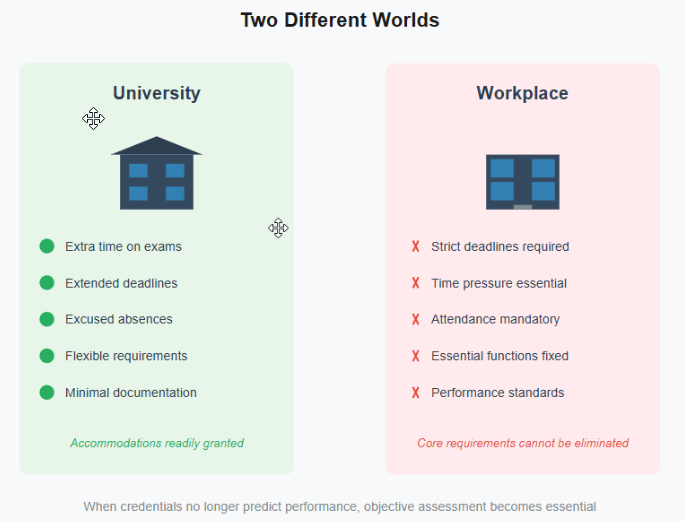
A student who graduated with accommodations that eliminated time pressure, reduced workload, or excused standard performance requirements may discover that these same limitations make them unqualified for positions where those elements constitute essential functions.