
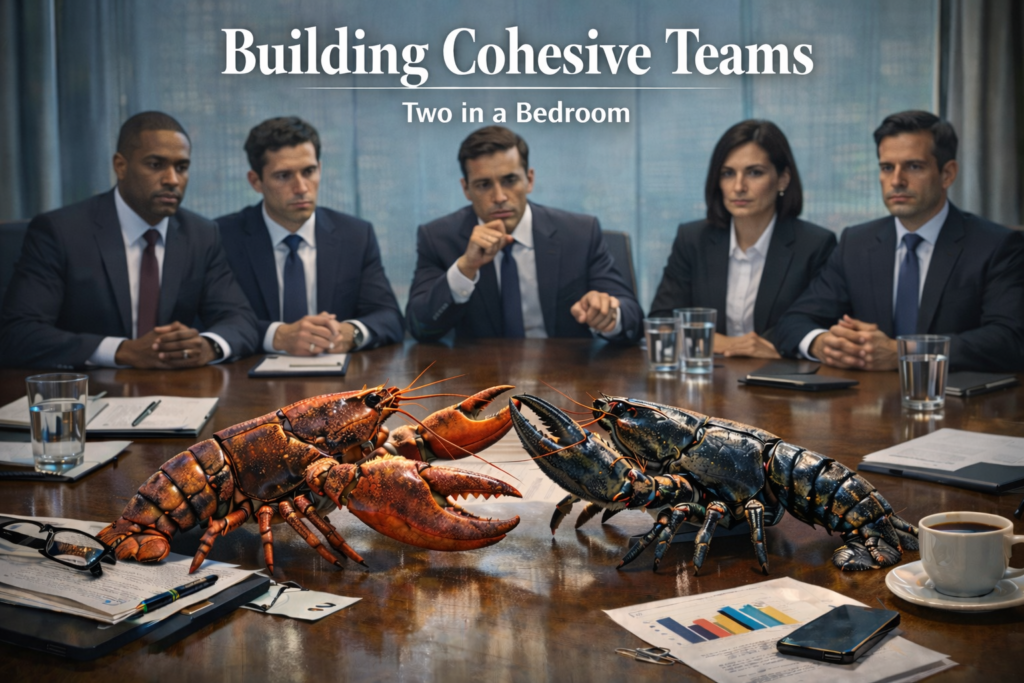
Have you heard of the phenomenon called two in a bedroom? I learned about the phenomena in a movie called “In the Bedroom”.When two lobsters wander into the same fishing trap, they often fight. They use their claws to establish dominance, and the winner may injure or even kill the other. Lobsters missing a claw are called “culls,” and they fetch less at market, so commercial fishers check lobster traps frequently to separate lobsters before they fight.
You may wonder what fighting lobsters has to do with building cohesive teams. The answer starts with a counterintuitive response to an executive interview question. We ask candidates to consider the following scenario. They get a promotion and can take three of the four people to their new team. The other gets left in their current position.
The current team includes two superstars. They both work hard at a high level; one person has the same capabilities, but a special needs child limits the number of hours they can work, and one who outworks all three but doesn’t have the same skills. I add a wrinkle by sharing that the team has galvanized around supporting the worker with a child with special needs.
When I wrote this question, I assumed most people would leave one of the latter two people behind. However, 32 of the last 50 people to answer this question have left a superstar behind. The logic? You can’t keep two lobsters in a trap, and you can’t have two stars on a team. At least that’s how the respondents explain their answer to me.
I disagree. Two stars can coexist. I’ve seen it happen a dozen times in the last ten years. Admittedly, that’s not enough for a scientific study, but we can learn a lot from the trends because we assessed their dynamics.
Most of the high-performing pairs had the following attributes related to the two stars:
- Both had self-deception scores below 65, indicating at least reasonable self-awareness. (Self-deception is an integration of a lack of an inflated self-perception and identifying common flaws)
- Each attributed success and failure to others in a moderate to low range. They did not blame others for failures or take all the glory for themselves.
- They always ranked in the upper half of respondents in terms of desire to collaborate. No lone wolves.
- Their cynicism and manipulation scores ranged from 30 or below. This means they trust others easily and don’t take advantage of them. In this case, they trust the other star.
- Stress tolerance scores were above the 60th percentile, indicating that both could handle pressure.
- Each had the Partner conflict style, suggesting they invest effort in a win/win solution, in either the first or second position
Most pairs had achievement scores above the 70th percentile, so they could be competitive as long as the other six factors were in their favor.
(Each of these scale scores is part of the Psybil® Assessment System)
Accelerating Two Stars Who Already Work Together
When two top-performers share these six attributes, they have a solid foundation. Many leaders want to leave them alone and let them work, but that would be a mistake and a waste of a rare opportunity for special upside. They could maximize these pairs by taking the following four steps:
1. Assign shared ownership of a high-stakes outcome. Most teams split responsibilities to reduce friction. Two stars with these profiles can handle the opposite. Give them joint accountability for a single critical deliverable, one where neither can succeed without the other. Their Partner conflict style allows them to negotiate rather than try to dominate each other. They will recognize when the other side has a better approach because they are not deceiving themselves. Shared ownership under these conditions creates compounding judgment rather than confusion, and you increase the likelihood of a top-tier outcome.
2. Increase the complexity of their decisions, not their workload. These two can handle ambiguity without retreating into blame or manipulation. Use that. Rather than adding more tasks, elevate the difficulty of the decisions they face. Bring them into strategic conversations early. Let them weigh in on resource allocation, trade-offs, and risk assessment. High achievement orientation paired with low cynicism means they will compete to produce the best outcome, not for visibility.
3. Make them review each other’s work. Before assignments come to you, route them through each other. This serves two purposes. First, balanced attribution means neither will suppress the other’s contributions. Second, collaboration scores above the 50th percentile mean they will treat the review as an opportunity to improve the output to maximize the benefits. Short feedback loops accelerate both of their work.
4. Give them permission to disagree with you. Two stars who lack self-deception and manage conflict through partnership can form a powerful check on leadership blind spots. Invite them to challenge your decisions as a pair. Frame it explicitly: “If you both think I’m wrong, I want to hear it.” Their stress tolerance means they will not avoid the conversation. Their low manipulation scores mean they will not weaponize it. You gain a corrective mechanism that most leaders never build.
5. Publicly frame their collaboration as the standard. High performers watch what gets rewarded. When you recognize these two, recognize the dynamic, not just the individuals. Name what they do well together: the way they resolve disagreements, the way they distribute credit, the way they elevate each other’s output. This does two things. It reinforces the behaviors that make their partnership work, and it signals to the rest of the team what excellence actually looks like. Achievement orientation stays productive when the definition of achievement includes how you operate with others.
When Two Stars Underperform and the Six Factors Are Missing
Now reverse the picture. You have two highly capable people who should be producing at a high level, and they are not. When you look at their profiles, you find the opposite of what the successful pairs share. Conflict styles skew toward competition or avoidance rather than partnership. Self-deception runs above 65. Attribution is distorted; they blame others for failure and absorb too much credit for success. Collaboration falls below the median. Cynicism or manipulation exceeds 30. Stress tolerance falls below the 60th percentile. Here is what to do.
1. Stop treating them as a pair and manage them individually. The instinct is to address the team dynamic. Resist it. When two stars lack these six factors, the dynamic between them is a symptom. The root issues, self-deception, distorted attribution, and low stress tolerance, live inside each person. Meet with each one separately. Set individual expectations. Hold individual reviews. Do not give them a shared problem to solve until you have addressed the individual deficits. Putting two people with high cynicism and competitive conflict styles on a joint project increases the likelihood of failure.
2. Confront the attribution distortion directly. Pull recent examples where one blamed the other for a missed outcome or claimed disproportionate credit. Present the evidence without editorializing. Ask them to walk you through their reasoning. People with self-deception scores above 65 genuinely believe their version of events. You will not argue them out of it in one conversation. The goal of the first conversation is to introduce a competing narrative. The goal of the second is to make them hold both narratives simultaneously. The goal of the third is to make them choose.
3. Reduce ambiguity in their roles immediately. Two stars with low collaboration and high manipulation will exploit any gray area between their responsibilities. Define boundaries with uncomfortable precision. Specify who owns which deliverables, who makes which decisions, and who reports to whom on which outcomes. This feels like micromanagement. It is not. It is containment. You are removing the conditions under which manipulation and cynicism produce results. Once the boundaries hold for 60 to 90 days, you can begin loosening them, but only if their behavior warrants it.
4. Test their capacity for partnership with low-risk collaboration. After the individual work has progressed, assign them a small joint task with clear success criteria and a short timeline. Watch three things: how they divide the work, how they handle a disagreement, and how they describe the outcome afterward. If the old patterns resurface (competitive conflict, blame-shifting, credit-hoarding), you have your answer. They cannot operate as a pair, and you should structure the team accordingly. If you see even marginal improvement, build on it incrementally.
5. Set a timeline and hold to it. These profiles do not change quickly, and some do not change at all. Give each person a clear development window, 90 days is reasonable, with specific behavioral benchmarks tied to the six factors. Avoid vague goals like “collaborate better.” Instead, provide concrete markers: “In the next project debrief, I expect you to name one contribution your colleague made that improved the outcome.” If they hit the benchmarks, extend the investment. If they do not, make the structural decision, move one of them. The data from the 50 candidates in your interview pool tells you what 32 of them already intuited: sometimes you cannot keep two lobsters in the same trap (bedroom).
Curious about how we assess teams like yours? Need more ideas on how to work with them?
Reach out to [email protected] and let’s talk.