
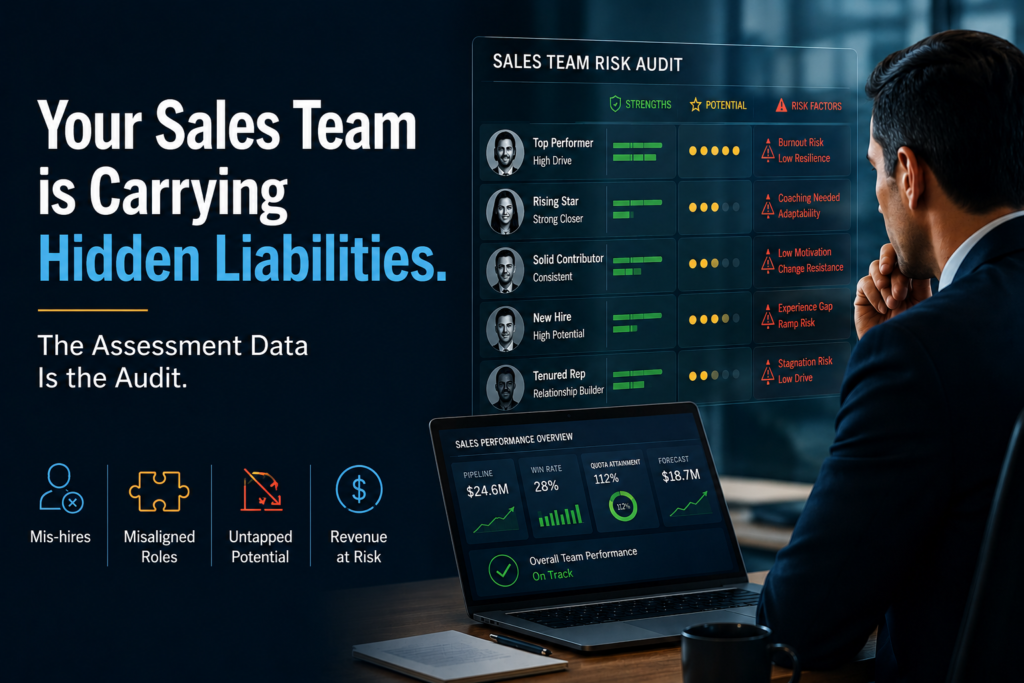
Your sales team is carrying hidden liabilities.The assessment data is the audit.
Most CROs can recite their pipeline number cold. Far fewer can tell you which reps are performing at the ceiling of their potential and which were never built for the role in the first place.
There’s a quiet reckoning happening in enterprise sales. Organizations spend enormous sums on recruiting, onboarding, enablement, and technology yet most sales leaders still rely on gut instinct and interview polish to decide who carries a bag. The result is a revenue org riddled with mis-hires, misaligned roles, and potential that never gets unlocked because nobody knew it was there.
Talent assessment tools change math. They replace intuition with data, and they do it at two inflection points that matter most: before someone joins the team, and long after they’ve settled in.
$240K
Average cost of a single sales mis-hire at quota
58%
Of new sales hires underperform in year one
3.2×
Revenue uplift in teams using structured assessment
Part I · The Hiring Side
The interview tells you who they want to be.
Assessment tells you who they are.
Sales candidates are, by definition, good at selling. That includes selling themselves. A polished answer, a confident close, a compelling story about last year’s quota, these signals are almost entirely performance. They tell you very little about whether someone will grind through a six-month enterprise deal, how they respond when a champion goes dark, or what derailers emerge when the quarter turns ugly.
A validated psychometric assessment strips away the performance layer. It surfaces the traits that actually predict durable sales success: grit under ambiguity, coachability, competitive drive balanced against conscientiousness, resilience through rejection, and the ability to read complex stakeholder environments. These aren’t things a 45-minute panel interview reliably detects not even a good one.
What a rigorous pre-hire assessment actually answers
- Does this candidate’s cognitive profile match the complexity demands of your average deal cycle?
- Are their motivational drivers aligned with how you compensate and how your culture runs?
- What derailer patterns are present and how likely are they to surface under pressure?
- Is this person wired for new logo acquisition, or are they better suited to expansion and retention?
- How will they fit into the existing team dynamic and where is friction most likely to emerge?
These questions have answers. They’re just not in a resume. Platforms like Psybil, built on over a decade of psychometric data across thousands of sales hires surface this intelligence inside a pre-hire workflow that connects directly to your ATS without slowing down the candidate experience.
Part II · The Coaching Side
You can’t coach someone you don’t understand.
Here’s what most sales managers have to work with: call recordings, CRM activity data, and their own observation. These are lag indicators. They tell you what already happened, not why it happened, and not what would change the outcome next time.
Assessment data on your existing team is one of the most underused assets in enterprise sales leadership. When you know a rep’s trait profile, you stop guessing at root cause. A rep who struggles in late-stage discovery isn’t necessarily a bad closer they may have a processing style that needs a different kind of support structure. A rep who burns through relationships with key accounts may be expressing a derailer pattern that shows up clearly in assessment data but is invisible on a call recording.
“Assessment data turns coaching from a post-mortem into a prediction. You stop asking what went wrong and start asking what this person will need to succeed next quarter.”
Without assessment data
Coaching is reactive. Managers diagnose problems after they surface — in missed quota, lost deals, or turnover. Root cause stays murky. Development plans end up generic and don’t land.
With assessment data
Coaching is proactive. Managers understand each rep’s trait-based strengths and derailers before they become problems. Development plans are specific, personalized, and measurably more effective.
Part III · The Strategic Case
A CRO’s job is to build a repeatable revenue machine.
That starts with understanding the humans inside it.
Sales technology has made real progress on the process layer — forecasting, sequencing, conversation intelligence, pipeline analytics. Almost none of it addresses the human variable. The person carrying the bag is still a black box.
Assessment platforms close that gap. Deployed across the organization at hire and periodically for existing team members they create a talent intelligence layer that informs every downstream decision: promotions, territory assignments, team composition, succession planning, enablement investment.
Three decisions a talent assessment platform makes meaningfully better
- Succession planning. Know which ICs have the cognitive and interpersonal profile to grow into management before you need to make that call under pressure.
- Territory and team design. Build pod structures and account assignments that play to individuals’ actual strengths not just their tenure or title.
- Attrition prediction. Misalignment between a rep’s trait profile and their role environment is a leading indicator of voluntary departure. It shows up in the data months before a resignation letter.
Closing
The question isn’t whether to use assessment data.
It’s how long you can afford not to.
Every quarter without talent assessment data is a quarter where hiring decisions are partly blind, coaching conversations miss the mark, and the human capital inside your revenue org is operating below its measurable potential.
Psybil is a fifth-generation all-in-one talent assessment platform built for organizations that take the human side of revenue performance seriously. With an open API, native ATS integrations, and over twelve years of enterprise assessment data, Psybil gives revenue leaders the talent intelligence layer their tech stack has always been missing.
If you’re building or benchmarking a sales team and want to see what assessment data looks like in practice reach out. The first conversation is always worth a 15 minute intro call.